
Michael Jackson's Ghosts Is Michael Jackson's Loving Tribute to Himself and His Ghoulish Eccentricities
At the rick of being controversial, Michael Jackson was a little off-the-wall!

Michael misrepresents its subject in myriad ways, particularly by depicting Jackson as a pretty normal, well-adjusted man, all things considered. Jackson was a bit of an oddball. He was a curious chap with some unusual characteristics. An average Joe, he was not.
Jackson was famous for being perhaps the greatest entertainer and live performer of his time, for his many eccentricities, and, you know, all that other stuff.
Sure, the Jackson of Michael behaves strangely at times, but he’s ultimately a solid dude who handled the pressures of mega-fame well.
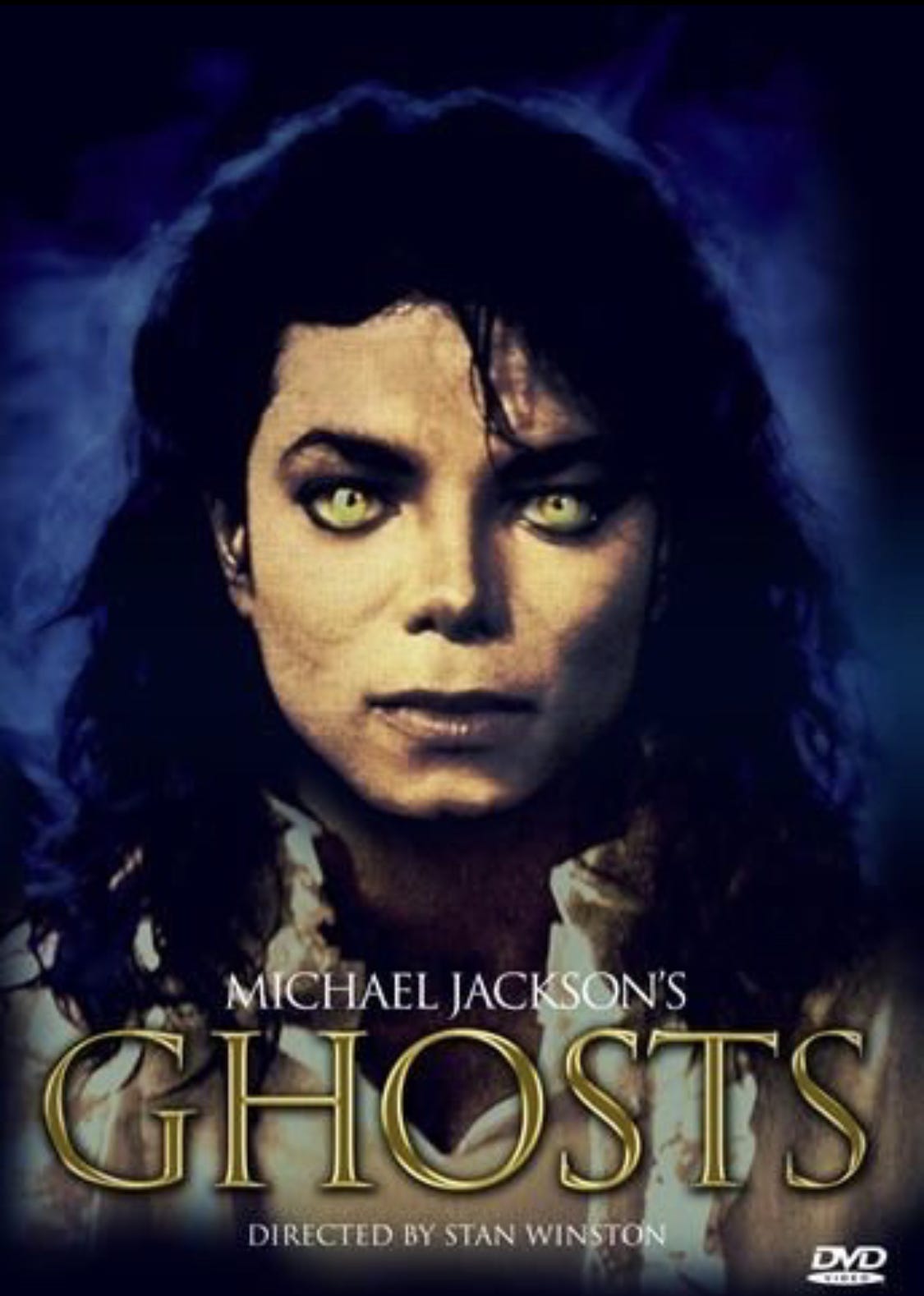
If Michael delusionally denies Jackson’s utter strangeness, his otherworldly talent, and infinite peculiarities, Michael Jackson’s Ghosts, a 15-million-dollar, 39-minute-long 1996 short film that at one point was both the longest and most expensive music video, foregrounds his weirdness.
Michael Jackson’s Ghosts doesn’t just place the pop icon’s quirkiness front and center: it’s a celebration of deviating from the norm, of following your muse wherever it leads, and sticking it to the dreary squares who venerate dreary mediocrity and punish nonconformity.
Those are all much more admirable messages than “You should let your children hang out with Michael Jackson unsupervised.” The Pied Piper figure at the center of the film, who lives in a haunted house, delights children with innocent mischief, tricks, and scares, and earns the anger, judgment, and hostility of a dull adult establishment, is billed as The Maestro, but he’s Michael Jackson.
As I wrote when I covered the short film for My World of Flops, Michael Jackson’s Ghosts is a staggeringly obvious and characteristically narcissistic allegory for Jackson’s struggles to be accepted by a world that revered him for his gifts and held him in suspicion because of his refusal to grow up and, you know, all the other stuff.
Michael is director Antoine Fuqua and screenwriter John Logan’s tribute to Michael Jackson, a normal guy in spite of all you’ve heard, seen, and know, and is a matter of the historic record. Michael Jackson’s Ghosts is Michael Jackson’s tribute to Michael Jackson, the misunderstood misfit.
Michael Jackson’s Ghosts began life as a short film called Is It Scary? directed by frequent Stephen King collaborator Mick Garris. It was going to accompany Addams Family Values in theaters and feature cameos by Christina Ricci and Jimmy Workman as Wednesday and Pugsley Addams.
That incarnation of the short film fell apart when Garris had to depart the project to direct The Shining, and the connection to Addams Family Values was abandoned. The revered sequel and preeminent Thanksgiving and camp classic ended up with a theme song from perhaps the only artist more talented than Jackson: Tag Team.
Jackson gave back 5 million dollars slotted for Is It Scary and ponied up fifteen million dollars of his own money to film a short film he hoped would top the iconic Thriller video. It did not. Michael Jackson’s Ghosts has some of the retro charm of the John Landis-directed pop culture touchstone, but where Thriller was a short film promoting one of the best songs of one of the greatest albums of all time, Ghosts features “Too Bad”, “Is It Scary”, and the title song. Those wouldn’t make fans’ top 50, or even top 100 favorite Michael Jackson songs.
Instead of being directed by Garris, the ambitious fright fest was helmed by legendary makeup artist and visual effects guru Stan Winston, a four-time Academy Award winner for Aliens, Jurassic Park, and Terminator 2: Judgment Day, for which he won Oscars for Best Visual Effects and Best Makeup.
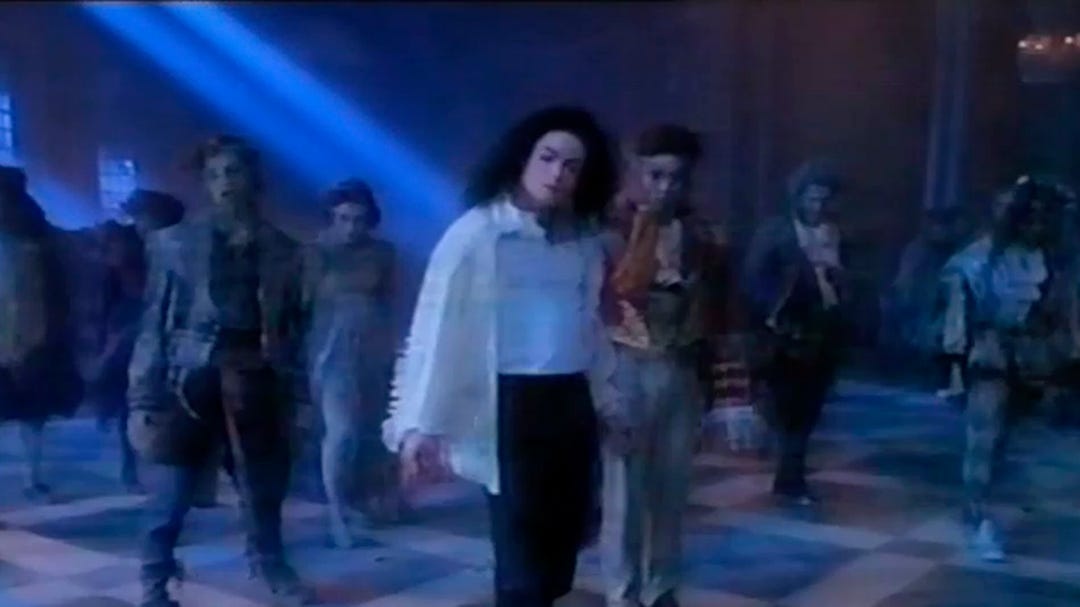
I’m writing about Michael Jackson’s Ghosts because, like the rest of the world, I’ve been thinking an awful lot about Michael Jackson’s legacy in light of Michael’s blockbuster success, but also because its story was co-written by Stephen King, along with Garris and Jackson, though its script is credited solely to Winston and Garris.
That strikes me as odd, since Garris is primarily a director, and Winston’s only other writing credit is for Pumpkinhead’s story, but Michael Jackson is the movie’s auteur. In addition to funding, producing, and co-creating the story of the short film, he plays multiple roles. There’s a reason this isn’t Stephen King’s Ghosts or Stan Winston’s Ghosts.
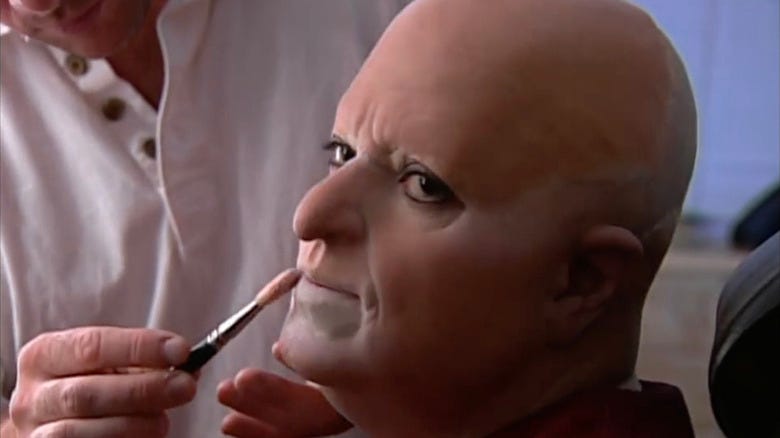
We open with a torch-wielding mob from the quaint small town of Normal Valley, led by a Mayor played by a bespectacled, nearly unrecognizable Michael Jackson in impressive whiteface make-up that makes him look like a morbidly obese Mike Johnson or slightly thinner Michael Lerner, approaching an imposing estate.
The townspeople sheepishly ask the Mayor why they can’t just leave the inhabitant of the Gothic mansion alone, on account of he hasn’t hurt anybody.
This engenders cognitive dissonance. Why join a torch-wielding mob confronting the village eccentric if your heart isn’t in it? Can’t they just tell the Mayor, “Nah, I’m good,” when he asks them to join his vigilante mob?
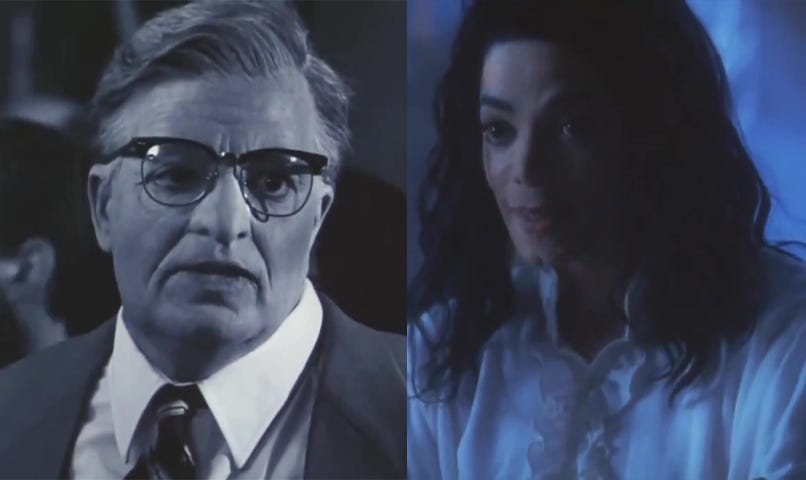
“He’s a weirdo. There’s no place in this town for weirdoes,” the Mayor explains unhelpfully. It’s not a crime to be a weirdo. It is, however, a crime to do that other stuff, which Ghosts seems to be hinting at in a way that’s deeply problematic.
One of the children smacks another and sneers, “It’s your fault, jerk. You just can’t keep your mouth shut.”
The Mayor tells Michael Jackson’s Maestro that he has to leave because he has a nice, normal town, full of normal people, and normal kids, and they don’t need freaks like him telling them ghost stories and performing tricks.
“You’re strange. And I don’t like it,” the Mayor tells the maestro.
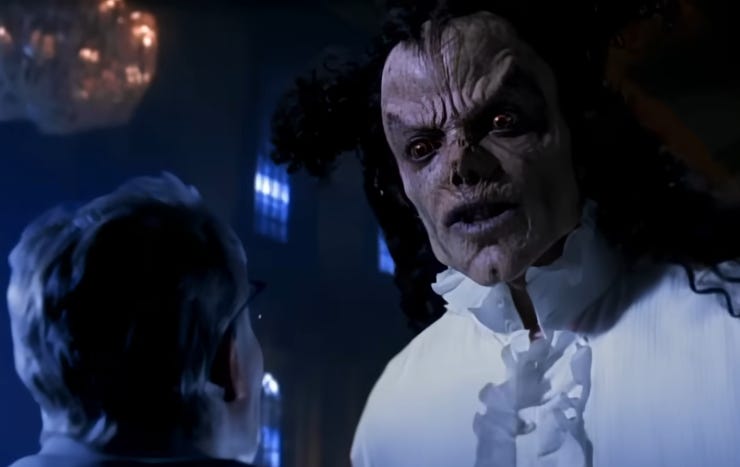
Since Jackson is playing both roles, it feels like The Wiz star is talking to himself. The Mayor represents the superego, coldly enforcing the dispiriting rules and codes of adulthood and respectability, while the Maestro is the child-like id devoted to doing what gives him joy, rather than what society demands of him.
The Mayor wants to punish the Maestro for doing weird things with adoring children when no one adults are around. He doesn’t understand that it’s all just innocent fun, and not a reason to make the wealthy, childless bachelor a pariah.
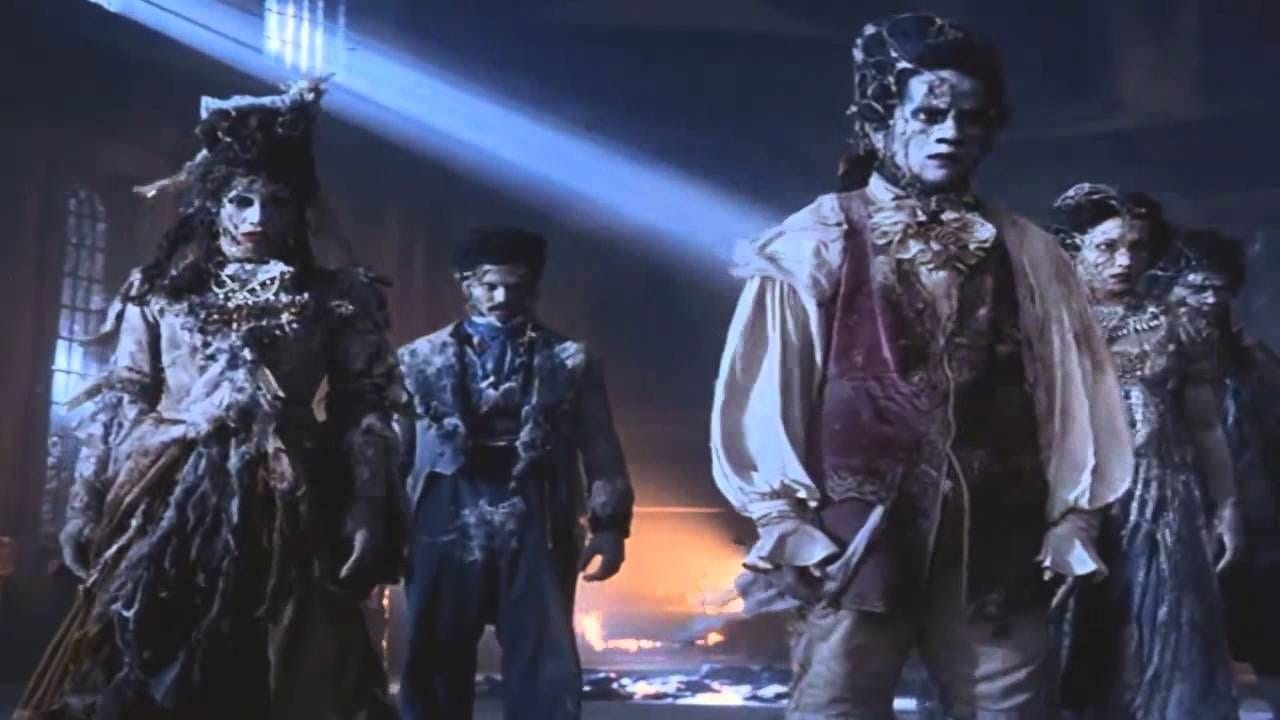
The Maestro proposes a scare-off. The first person to get scared has to leave. The Mayor and the reluctant, scared torch-wielding mob immediately get scared by the Maestro introducing his “family” of boogying Victorian ghosts, but he keeps them from fleeing in horror so that he can entertain and terrify the people of Normal Valley.
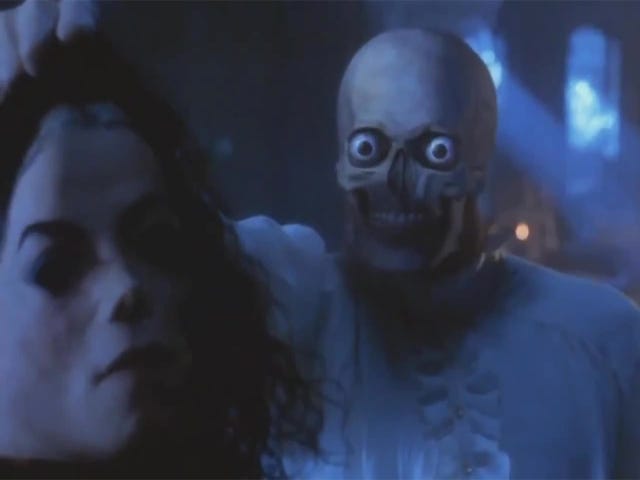
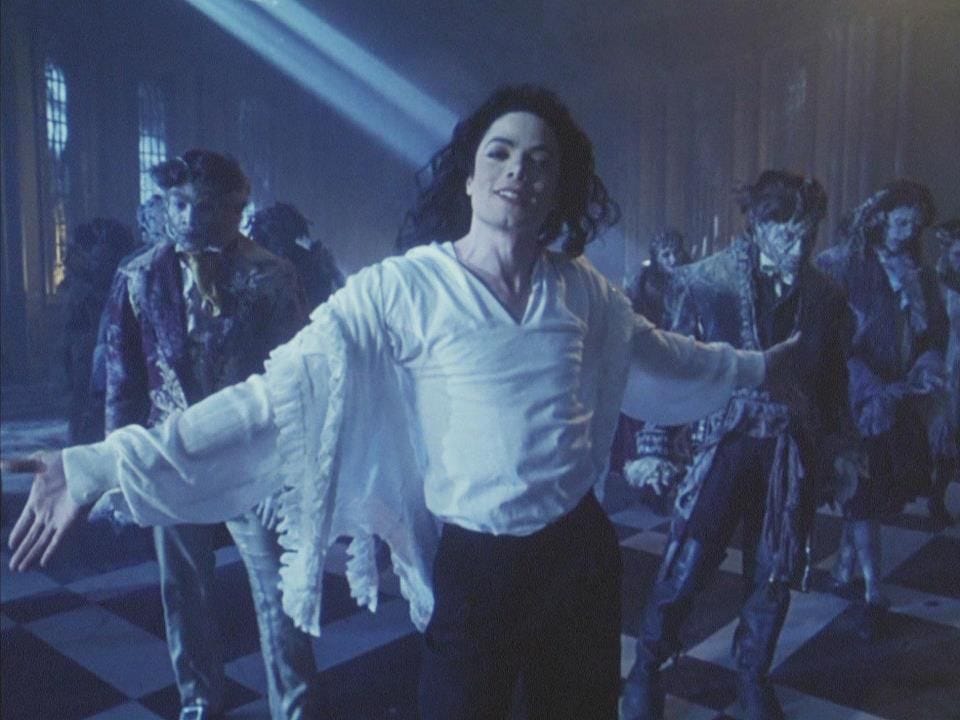
As its title suggests, Michael Jackson’s Ghosts follows the same template as the “Thriller” music video, but with Jackson leading a troupe of otherworldly spirits through elaborate dance routines rather than a funky army of the undead.
When Jackson dances, the awkward self-consciousness of his acting dissipates instantly, and he loses himself in the rhythm. “2 Bad”, “Is It Scary”, and “Ghosts” are percussive rather than melodic. They’re made for dance floors and production numbers rather than headphones.
Michael Jackson’s Ghosts has tremendous assets in Jackson’s singing and dancing, and Winston’s make-up and visual effects. As a director, Winston makes sure that we get good looks at the monster makeup of tremendous quantity and quality. Like Jackson, he was the best in the world at what he did and took great pride in his artistry.
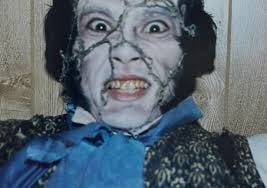
That artisanship extends to its use of CGI. That was a relatively new technology when Ghosts was made, but Jackson had experience with it through the face-morphing sequence in his groundbreaking 1991 video “Black or White.”
Jackson and Winston use CGI artistically to achieve spectacle impossible through conventional methods. CGI can feel soulless and impersonal, but in 1996, it must have seemed like magic.
The Maestro and his ghostly relatives boogie their way through dance sequences choreographed in part by Jackson himself. In the short film’s most impressive segment, an impish spirit invades the Mayor’s body, and for three minutes, the embodiment of churlish, arbitrary authority dances like Michael Jackson because, under all those layers of make-up and a surprisingly convincing fat suit, he is Michael Jackson.
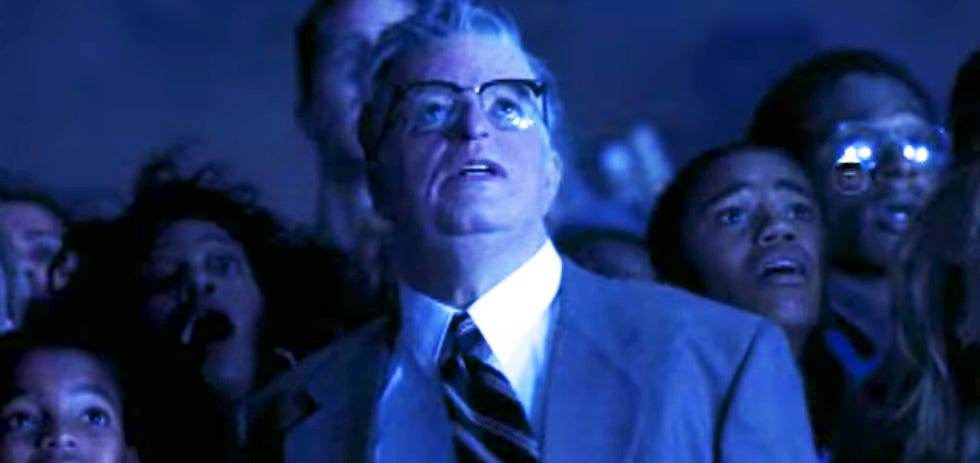
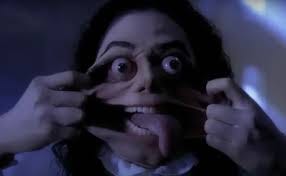
Jackson’s moves are so distinctive—primarily because he stole them from Corey Feldman, his biggest inspiration—that even under layers of padding, it’s impossible to mistake him for anyone else. That’s true even of a similarly memorable scene where Jackson assumes the form of a skeleton to freak out the Mayor and delight children.
The only person in the torch-wielding mob who seems to have a genuine problem with the Maestro is the Mayor, and some disapproving parents. Otherwise, they’re less vigilantes out to enforce the town’s unwritten law against being weird than an adoring crowd full of children agog with excitement over being in the presence of the world’s greatest entertainer.
The children enjoy being scared. They love the Maestro’s wackiness. They don’t want him to grow up or conform. In that respect, this feels less like an innocent message about being yourself than propaganda from one of the richest, and consequently most powerful, pop stars in history.
As a showcase for Stan Winston’s make-up, Michael Jackson’s dancing, music, and love of horror, Ghosts is tons of fun. It’s just a shame about everything else. As self-mythology, it’s a lot more concerning.
I enjoyed Ghosts a lot more this time than when I wrote about it for The A.V. Club. At the risk of being controversial, in addition to being a little odd, Jackson was also an incredible performer with a clear-cut vision for what he wanted to do and how he wanted to do it.
Michael Jackson’s Ghosts made a believer out of me. I now think that people should not be shunned and punished for being unusual, but they definitely should be shunned and punished for, you know, all that other stuff.
If you missed the Kickstarter for my tenth book and first novel, a Freddy Got Fingered-themed parody of Five Nights at Freddy’s at https://www.kickstarter.com/projects/2104527448/make-five-nights-at-freddy-got-fingered-a-ridiculous-reality/pledge/new
Purchase The Fractured Mirror, my just-released magnum opus about American movies about filmmaking, which has a foreword from Gremlins 2: The New Batch director Joe Dante and illustrations from Felipe Sobreiro (Return of the Blues Brothers, The Authorized Al), from me here or from Amazon here
Sign up for an annual paid subscription to Nathan Rabin’s Bad Ideas at
Nathan Rabin’s Bad Ideas and get a free copy of The Fractured Mirror and the “Weird Al” Yankovic-themed coloring book The Weird A-Coloring To Al for free!
'One of the children smacks another and sneers, “It’s your fault, jerk. You just can’t keep your mouth shut.”'
WHAT??!?!??!!
Would love to see how the original Stephen King script was different