
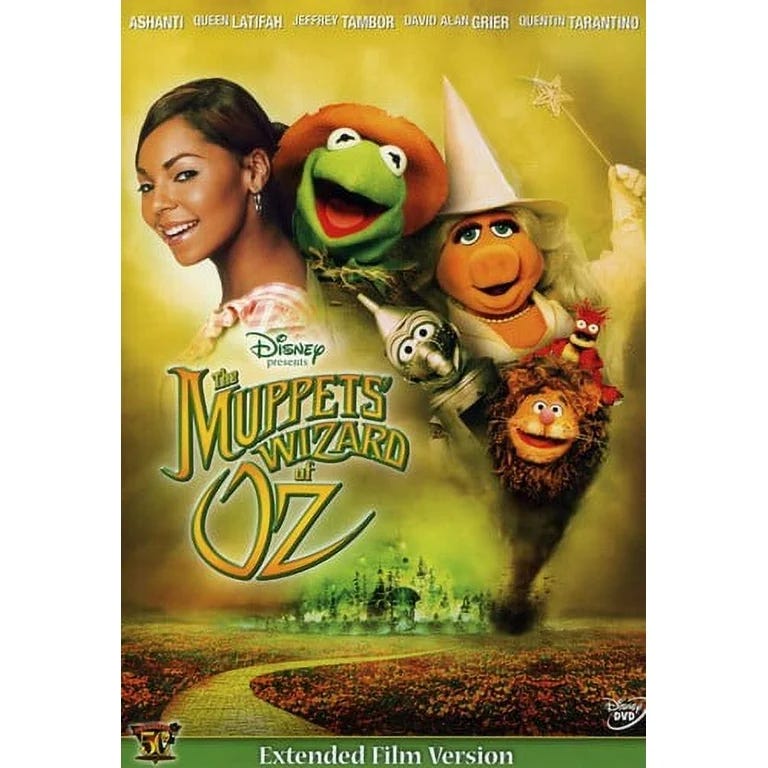
Introducing Muppetational, a new column celebrating the Puppetry Arts. We Begin With a Mortified Look Back at 2005's The Muppets' Wizard of Oz, the Star Wars Holiday Special of the Jim Henson World
This is gonna be fun!

Welcome, friends, to the first entry in Muppetational: A Celebration of Puppetry Arts. It’s a new column devoted to exploring the wonderful world of Jim Henson. It’s inspired by my autistic seven-year-old son Harris’s obsession with puppets. For the last few years, his special interest has been Muppets.
Harris has seen every episode of the Muppet Babies reboot hundreds of times. We’ve watched the Muppets’ 30th anniversary special thousands of times. I know it by heart. My son may be the only person in the world who watches Sam & Friends, the crude, black-and-white television show that introduced Kermit the Frog.
I consider Jim Henson and Frank Oz two of the greatest performers of the twentieth century. It is hard to overstate the importance of Henson’s legacy. He single-handedly made the world a better, kinder, and more whimsical place. His death at 53 is one of pop culture’s great tragedies.
Every month, I’ll write about a different Henson-related project for Muppetational. I’ll be focusing on random detritus and semi-obscure oddities rather than the milestones that everyone knows. I’m going to write about ephemera that even Muppets fans don’t know exist.
I want to write about projects that are not on Disney+ and will never be on the popular streaming service due to a total absence of demand.
If the column is a big success, I’ll write about two Muppetational obscurities a month.
Given my career and fascination with failure, it seems appropriate to start with 2005’s The Muppets’ Wizard of Oz. Despite my fixation on flops and deep reverence for Henson’s creations, I did not know that the notorious TV movie existed until a few days ago.
The Muppets’ Wizard of Oz desecrates two American institutions simultaneously. It’s redolent of The Star Wars Holiday Special in that its mere existence engenders cognitive dissonance. How can something this woefully misguided be an official Muppets production? Who let this happen? Why? How?
The Muppets’ Wizard of Oz casts pop star Ashanti as a contemporary Dorothy Gale who works in a diner for her Auntie Em (Queen Latifah) and Uncle Henry (David Allan Grier) while dreaming of pop stardom.
“You’re never gonna get to where you wanna be until you’re happy with who you are,” Auntie Em tells her niece. How considerate of the movie to gift wrap its message with a shiny bow within the first five minutes.
Dorothy misses her big audition with the Muppets, but she catches up with their tour bus. When a frustrated Kermit the Frog says of their pursuit of a future star, “Who’d have thought that it would be so hard to find an all-American girl with talent?” Pepe the Prawn replies, “Yeah, how do the producers of Girls Gone Wild do it?”
Girls Gone Wild was a desperation, exploitation, and alcohol-fueled pop culture phenomenon where human garbage fire Joe Francis coerced drunken, college-age party girls into exposing their naked breasts on camera for posterity in exchange for booty shorts, a tee-shirt, or a hat and a lifetime of shame and regret. It’s only slightly classier than bum fights.
The jarringly out-of-place joke lands with a painful thud. They’re throwing down the gauntlet and letting us know that these are not your mother’s Muppets. That’s because the Muppets of a previous generation brought joy, laughter, and happiness to a world desperately in need of mirth and merriment, and these off-brand Muppets suck.
When Dorothy tries to give the Muppets her demo, Miss Piggy says she does not have time for groupies and that they’ll have to get it off Napster. Great art is timeless. The Wizard of Oz is timeless. Hell, Return to Oz is timeless. The Muppets’ Wizard of Oz, in sharp contrast, is the most 2005 artifact imaginable. It’s chockablock with pop culture references that were already dated when the TV movie debuted to solid ratings and withering reviews. They’re positively antiquated now.
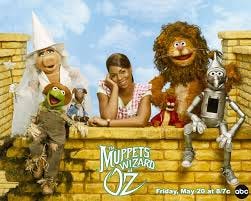
A tornado then transports our heroine and her sidekick Toto, who in this incarnation is not a little dog but rather Pepe the King Prawn.
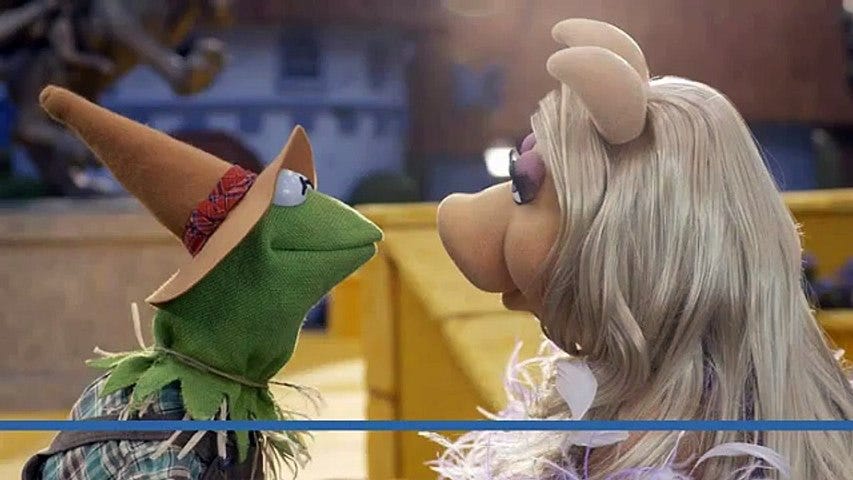
In Oz, Dorothy and Pepe encounter a scarecrow on a post. Kermit has historically been the most grounded of Muppets. He’s the glue that holds everything together, the affable, eminently relatable leading man. He’s got a good head on his shoulders, so it feels like a terrible miscalculation to cast him as a character whose defining characteristic is that he literally does not have a brain.
Kermit-as-Scarecrow looks a little like a man being crucified on his post, leading the miscast amphibian to make a joke about The Passion of the Christ, Mel Gibson’s hard-R, ragingly antisemitic account of the brutal torture Jesus endured in his final hours. .
In classic Muppets tradition, The Muppets’ Wizard of Oz wants to operate on multiple levels. Instead of having jokes that fly above the heads of little ones but delight adults, The Muppets’ Wizard of Oz has references that will mean nothing to children and mortify grown-ups. In seeking to satisfy everyone, this ends up appealing to no one.
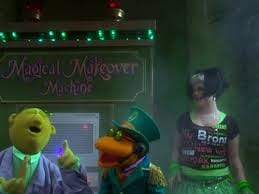
Dorothy, Toto, and the Scarecrow, then hook up with Gonzo’s hyper-intelligent Tin Man, or rather Tin Thing, and Fozzie Bear’s Cowardly Lion. Other Muppets play themselves. Bunsen and Beaker play scientists who created Emerald City’s Magic Makeover Machine. Ashanti’s Dorothy enters it, and emerges Kelly Osbourne, who, along with her brother and mother, was briefly a thing. It’s a weird gag with weird racial overtones, but who in 2005 could say no to a Kelly Osbourne cameo?
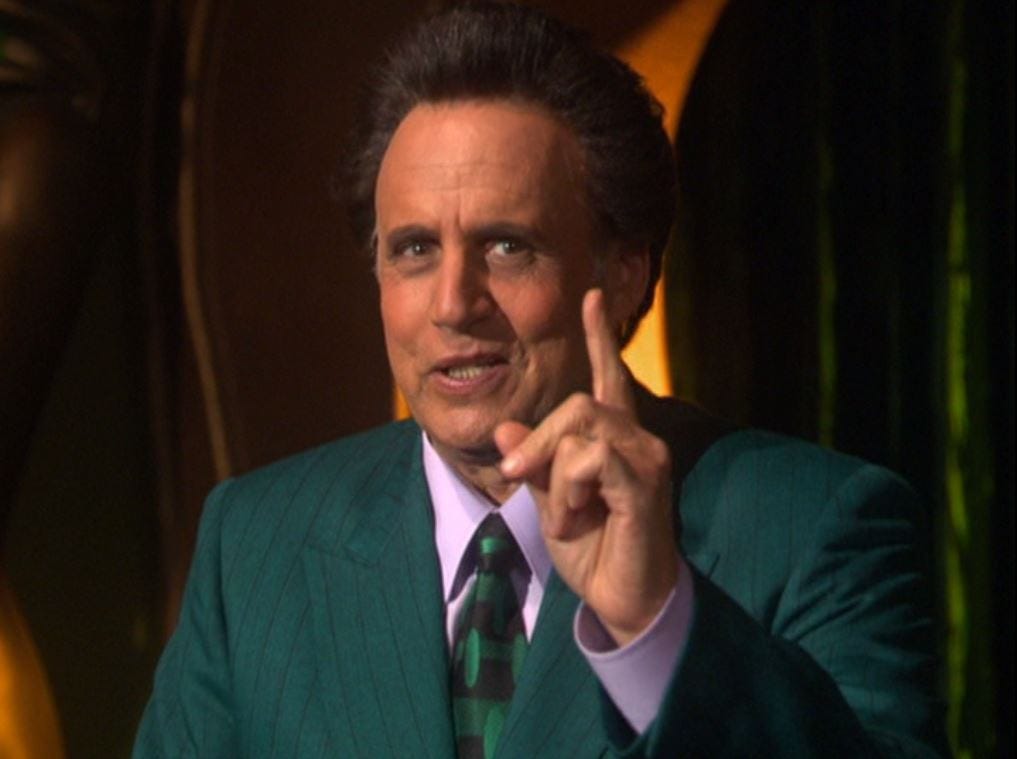
Our heroes ease on down the yellow brick road until they meet a Wizard they’re convinced will solve all their problems. The great character actor and deeply problematic human being Jeffrey Tambor plays the Wizard as a cynical and manipulative shape-shifter, but that’s only the beginning of the disconcerting elements of his first scenes.
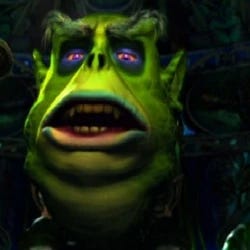
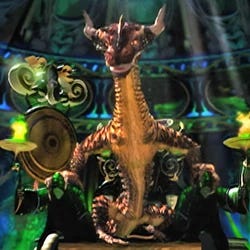
Dorothy, Toto, the Scarecrow, the Cowardly Lion, and the Tin Thing experience different images when they look at the Wizard. This is realized through CGI that is primitive and garish even by 2005 standards. The Cowardly Lion sees him as a poorly designed dragon. To Dorothy and Toto, he’s a glowy green blob with a distinct resemblance to Mucinex’s anthropomorphic mucus mascot. For the Cowardly Lion, he’s a dragon. The scarecrow witnesses a slightly different glowing emerald blob. For The Tin Thing, the Wizard appears first as a sexy CGI woman straight out of Foodfight!/the uncanny valley, and then as an even sexier chicken.
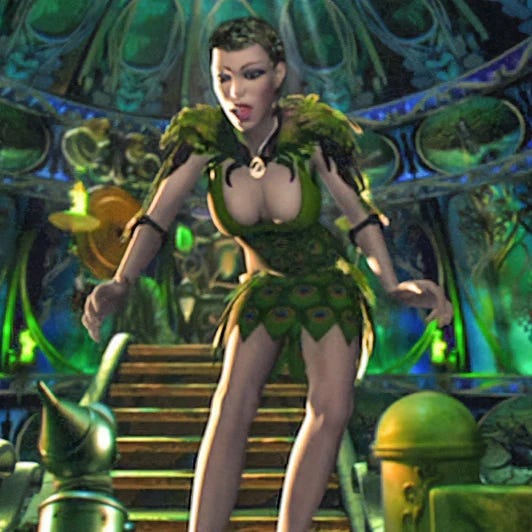
There’s something deeply disconcerting about CGI in a Muppet project. It feels heretical and antithetical to the handmade, artisanal sensibility of Jim Henson and company. The Muppets are all about people and puppets, puppeteers who learned their craft through years of painstaking practice and felt creatures the public has come to know and love as if they were their own family members.
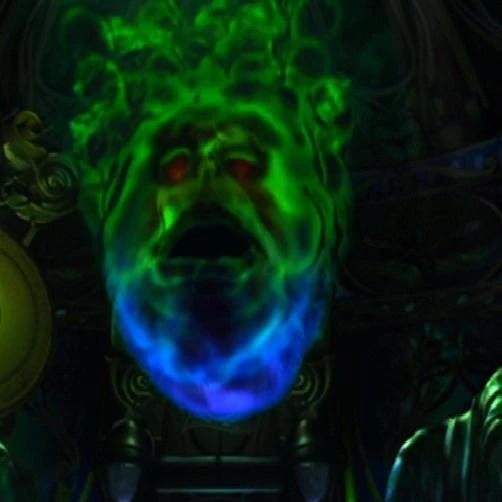
It’s cheaper and easier to use ugly CGI instead of creating puppet versions of the Wizard’s different iterations, but part of the magic of Muppets lies in its old-school, time and labor-intensive artistry. Remove that from the equation, and you have something that feels cheap, vulgar, and unbecomingly modern.
The Wizard tells Dorothy that he’ll make everyone’s dreams come true if she brings him the eye of the Wicked Witch of the West, a Diva in leather played by Miss Piggy, who is filming her own reality show.
When Dorothy and the Wicked Witch engage in fisticuffs, Rizzo observes, “Somebody’s going to get witch-slapped!”, which is a mere letter away from a profanity.
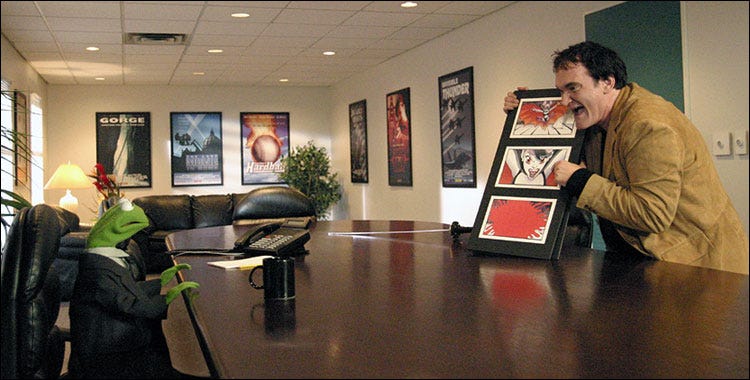
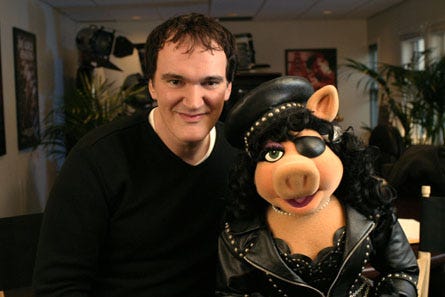
The film’s reality is then shattered by a fourth wall-breaking cameo from Quentin Tarantino, positively marinating in coke sweat, in which he’s pitching a Kill Bill-style fight scene to Kermit the Frog in a conference room that grows progressively more surreal, violent, and sexual until he’s ranting manically about Muppets morphing into each other and “Scooter turning into a big, busty vampire vixen who explodes in a sea of crimson blood.”
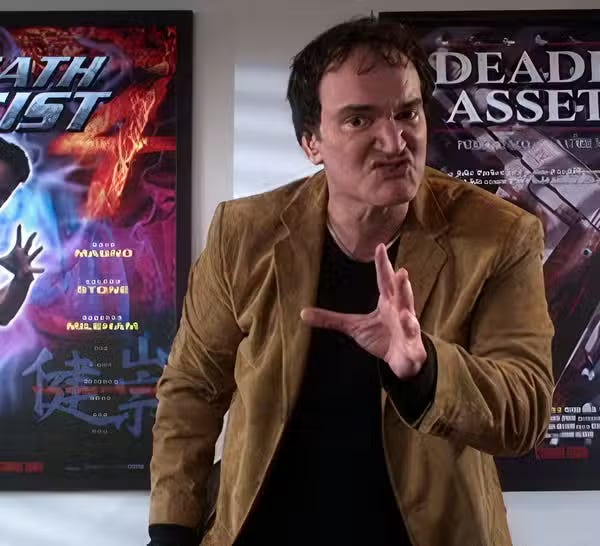
I’m sure there’s someone out there whose sexual kink involves B-list Muppet Scooter becoming a voluptuous blood-sucker. It’s a big world. It takes all kinds. But, like so much of this singularly misguided project, this lurid fantasy does not belong in a Muppet movie.
When our heroes return to the Wizard with the Wicked Witch’s magic eye, they discover that he’s just a balding tour bus driver from Hollywood who is even more of a phony than most showbiz wannabes.
We end where we begin, but with Dorothy now realizing that there’s no place like home.
With The Muppets’ Wizard of Oz, our favorite troupe of puppety oddballs strayed too far from what has made them icons deeply interwoven in the fabric of American culture.
I made the mistake of watching the extended version of The Muppets’ Wizard of Oz. Those 100 minutes passed very slowly. My viewing experience was not enhanced by the fact that it lasted 13 minutes longer than the broadcast version.
I’m very excited to immerse myself even further into the world of Jim Henson with Muppetational. Heaven knows we’ve got nowhere to go from here but up. Things can only get better!
Purchase The Fractured Mirror, my just-released magnum opus about American movies about filmmaking, which has a foreword from Gremlins 2: The New Batch director Joe Dante and illustrations from Felipe Sobreiro (Return of the Blues Brothers, The Authorized Al), from me here or from Amazon here
Great article, can't wait for more!
We have a bootleg DVD of this for some reason. I've never watched it, but I distinctly remember hearing it playing in another room while I was working on something else, and hearing the Passion of the Christ joke